
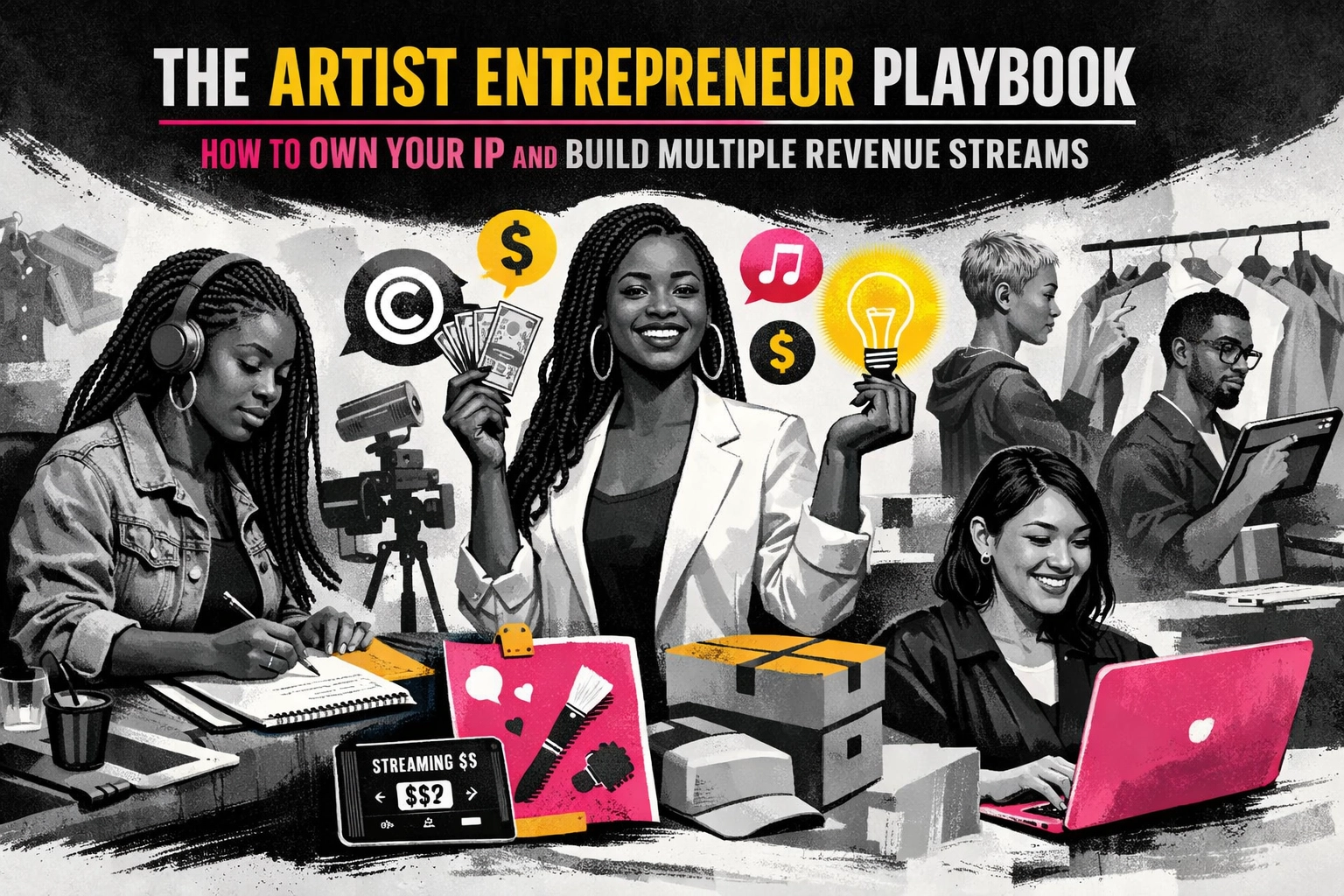

Let’s talk about something nobody really prepares us for.
The moment our creative work starts to scale.
You know what I mean?
When your short film gets attention. When your book lands on someone’s desk. When your script gets a second look.
That’s when the questions start rolling in.
Who owns this? What rights are we talking about? Can we adapt this?
And if you don’t know the answers…
You’re leaving money and creative control on the table.
Why IP Ownership Isn’t Just Legal Jargon
Here’s the thing about intellectual property…
It’s not just about protecting your work.
It’s about building your work into something bigger.

Think of IP as your creative real estate.
You own the land. You decide what gets built on it. You determine who gets access and how much they pay for the privilege.
When you own your IP, you control:
- The original story
- The characters
- The world you’ve created
- How it gets adapted
- Where it appears
- Who profits from it
Every single time someone wants to use your work? You’re in the driver’s seat.
That’s power.
That’s leverage.
That’s how you turn one idea into multiple income streams…
As a storyteller and indie film studio founder.
That’s how I think about it.
The Multi-Platform Strategy
I’m going to share something with you.
When I created COACH QUINN, I didn’t just write a book.
I built a universe.
The book. The audiobook. The TV pilot. The potential for merchandise, live events, courses, speaking opportunities.
Same with Of Music and Men.
It had all of this, plus a narrative podcast series.
All of it stems from owning the IP.
Because here’s what most artists don’t realize early enough…
Your story can live in multiple formats simultaneously. And each format reaches a different audience. Each format generates a different revenue stream.
A reader might not watch your show. A viewer might not read your book. But when you own the IP? You can serve them all.
3 Strategic Upgrades to Add to Your Pitching Arsenal
Let’s get practical.
You’re pitching your work. Maybe it’s a film. Maybe it’s a series. Maybe it’s a book you want adapted.
Here are three things to add to what you’re already doing:
1. The Rights Breakdown Document
Create a one-pager that shows exactly what rights you’re offering and what you’re keeping.
Film rights? Sure.
Merchandising? That’s yours.
International adaptation? Let’s talk.
This shows you’re business-savvy. It shows you understand the game. And it immediately positions you as someone who knows their worth.

2. The Revenue Roadmap
Show them the vision.
This isn’t just a book. This is a book that becomes a series that becomes a franchise that becomes a cultural moment.
Map out the potential:
- Platform one: Book sales
- Platform two: Audiobook
- Platform three: TV/Film adaptation
- Platform four: Merchandise
- Platform five: Speaking/workshops
- Platform six: Licensing deals
When investors or studios see this? They see scalability. They see someone who thinks beyond the first deal.
3. The Proof of Concept Portfolio
Build small wins that demonstrate demand.
Sold 100 books independently? That’s proof.
Got 1,000 newsletter subscribers? That’s an audience.
Self-produced a short film that got festival attention? That’s validation.
Don’t wait for permission to prove your concept works. Create the proof yourself. Then bring that to the table.
The Reality of Multiple Revenue Streams
I’m not going to sugarcoat this.
Building multiple revenue streams takes time.
It takes strategy.
It takes ownership of your work from day one.
But here’s what it gives you back:
Freedom.
Freedom to say no to deals that don’t serve you.
Freedom to pivot when one stream slows down.
Freedom to invest in the next project without waiting for permission.

When COACH QUINN exists as a book, an audiobook, and a TV pilot, I’m not dependent on any single platform or decision-maker.
One door closes? I’ve got three others already open.
That’s the power of the multi-hyphenate approach.
What This Actually Looks Like in Practice
Let me break down a real scenario.
You write a screenplay.
Option A: You sell it outright. Get paid once. Lose control of the story. Hope they make it the way you envisioned.
Option B: You retain the IP. License the screenplay for a specific use. Keep book rights. Keep merchandise rights. Keep international rights. Get paid for the license and build additional streams from the same story.
See the difference?
Option B requires more negotiation. More clarity. More confidence in your worth.
But Option B builds wealth.
Option B builds a business.
Your IP, Your Empire
Here’s what I want you to walk away with.
You’re not just an artist.
You’re an entrepreneur building a creative empire.
And empires aren’t built on single transactions. They’re built on owned assets that generate value over time.
Your stories are your assets.
Treat them that way.
Protect them legally. Scale them strategically. Monetize them intelligently.
The industry wants to convince you that giving up ownership is the only way to get your work seen.
That’s a lie.
Ownership is the way forward. For indie creators. For storytellers who refuse to compromise. For multi-hyphenates who see the bigger picture.
If you’re ready to see what this looks like in action, check out COACH QUINN.
It’s a blueprint for how one story can become multiple platforms, multiple opportunities, multiple revenue streams.
Book. Audiobook. TV pilot.
All owned. All controlled. All intentional.
That’s the playbook.
Want more insights on building your creative business? Subscribe to my LinkedIn newsletter where I share weekly thoughts on storytelling, entrepreneurship, and owning your creative future.